
From Amazon.com
By Roger C. Parker (Dover, NH)
Important book for shortline railroad
lovers and model railroaders,
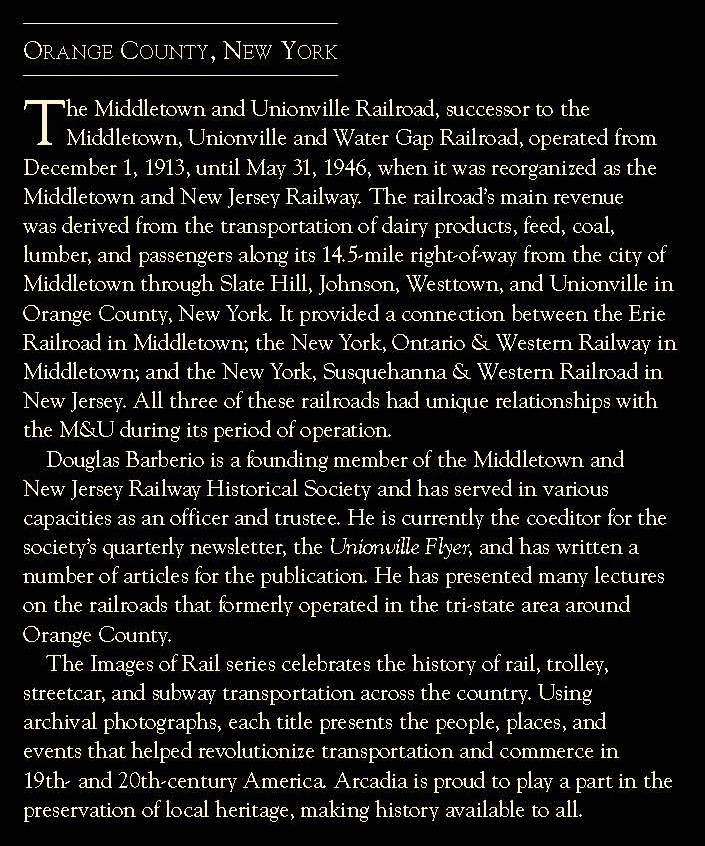
There are three types of readers who will appreciate Donald
Barberio's Middletown and Unionville Railroad, part of Arcadia Publishing's
Images of Rail series.
One is lovers of "high character" short line railroads. Although less than 15
miles long, the Middletown and Unionville railroad served its upper New York
State communities for over 100 years. Its rails hosted a wide variety of steam
and diesel engines and a variety of freight and passenger rolling stock. Like
many short line railroads, money was always tight, and the rolling stock and
line side structures reflected the line's pragmatic, "make do," and home-made
fiscal constraints.
Another category of readers certain to appreciate the Middletown and Unionville
Railroad is model railroaders searching for inspiration in terms of a
"practical" prototype to model. With just 15 miles of track, the Middletown and
Unionville is long enough to be interesting, with its numerous interchanges with
larger lines, yet it's short enough to be practical.
More important, the Middletown and Unionville played an important role in the
communities and industries it served,including the dairy industry. As a result,
there are numerous photographs of creameries, powdered milk producers, and
cheese factories located along the line. There are also some great photographs
of large factories that produced products like abrasive files and piano keys.
Like many short line railroads in the early Twentieth Century, the line's
profits were based on incoming shipments of raw materials like cattle feed and
farm implements, and outgoing finished products. Modelers looking for signs
reflecting a vanished area will find many in the pages of this book.
Contributing to the line's appeal is the variety of equipment from its larger
connecting railroads it connected with, and often detoured over its tracks.
Finally, amateur historians interested in visually tracking the changes that
have taken place in American, and, especially, upper New York State towns will
also appreciate Douglas Barberio's Middletown and Unionville Railroad. It's
rather disturbing, in fact, to look at photographs of once-prosperous factories
and industries that once provided employment for hundreds of area residents, and
realize that none of the industries survive today.
I was fortunate to receive a pre-publication review copy of The Middletown and
Unionville Railroad, but, having spent several pleasant hours with it, I would
have gladly paid for it. It's a fine volume and an excellent value.
Now available on the O&WRHS Sales Page
Any Questions please contact Doug Barberio at: dwdrill@frontiernet.net